Guides
How to set boundaries with customers (without the awkward conversation)
· 6 min read
“Can you do it for tomorrow?” “Can I pay on the day?” “Can you knock a bit off?” Every home baker knows these messages, and most of us say yes far too often, because saying no to a lovely customer feels awful. The good news: you don't have to say no in the moment if you've said it beforehand, clearly and kindly. Here's how.
Boundaries aren't rude. They're how you stay in business.
Every rush order you squeeze in, every unpaid design change and every cake nobody collects comes out of your evenings and your profit. Clear rules don't put good customers off. They reassure them, the same way a shop with opening hours and a returns policy feels more trustworthy than one without.
The trick is to set them before anyone asks, and to put them where customers will actually see them. Then a “no” isn't personal. It's just how your bakery works.
The six rules every home bakery needs
You don't need a long policy document. Six short rules cover almost every awkward moment:
1. How much notice you need
Ingredients have to be bought, sponges baked and cooled, decorations planned. Without a minimum, every week fills up with “can you do it for tomorrow?”.
A good place to start: 3 days for everyday bakes, 2 weeks for custom designs.
2. A deposit to book the date
It turns “maybe” into “yes”. The customers who pay one are the ones who turn up, and it covers your ingredients if they don’t.
A good place to start: Half the price to book, the rest before pickup.
3. What happens if they cancel
Decide it once, calmly, instead of in the middle of a tearful message the night before.
A good place to start: 7+ days ahead: refund minus the deposit. 3–6 days: half back. Later: no refund.
4. When to collect
A window stops pickups at 9pm on a Sunday, and saying what happens to uncollected orders saves a fridge full of other people’s cakes.
A good place to start: A 4-hour window. Not collected within a day? It can’t be kept, and it’s still charged.
5. How many design changes are included
Every sketch, mock-up and colour swap is unpaid time. A set number of free rounds keeps it fair for both of you.
A good place to start: One round of changes included; more may cost extra.
6. When you reply to messages
You’re allowed evenings off. Saying when you answer means nobody expects a reply at 11pm, including you.
A good place to start: Weekdays, 9 to 5.
How to say no without sounding like a no
Tone does most of the work. Point to your rule, offer what you can do, and don't over-explain. A few swaps that keep things warm:
No, I can’t do tomorrow.
My calendar’s full that soon. The earliest I can do is Friday. Would that work?
That’s too cheap, I won’t do it for that.
That design takes about 6 hours, so it starts at $95. I can suggest a simpler one closer to your budget.
You’re too late to cancel.
As my policy says, cancellations this close aren’t refundable, because the ingredients are already bought.
I’m not changing it again.
Your order includes one round of changes. I’m happy to do another for $15.
And if someone pushes back? Repeat the rule once, kindly, and leave it there. You don't owe anyone a debate about your own business.
Put your rules where customers actually look
Rules only work if people see them before they order, not after:
- On your order form, with a tick box: “I've read these and I'm happy to go ahead.” Nobody can say they didn't know.
- In your Instagram bio and story highlights, as a link or a simple image people can screenshot.
- In your confirmation message and invoice, so the deposit and cancellation terms are in writing for that order.
How SweetMargins does it for you
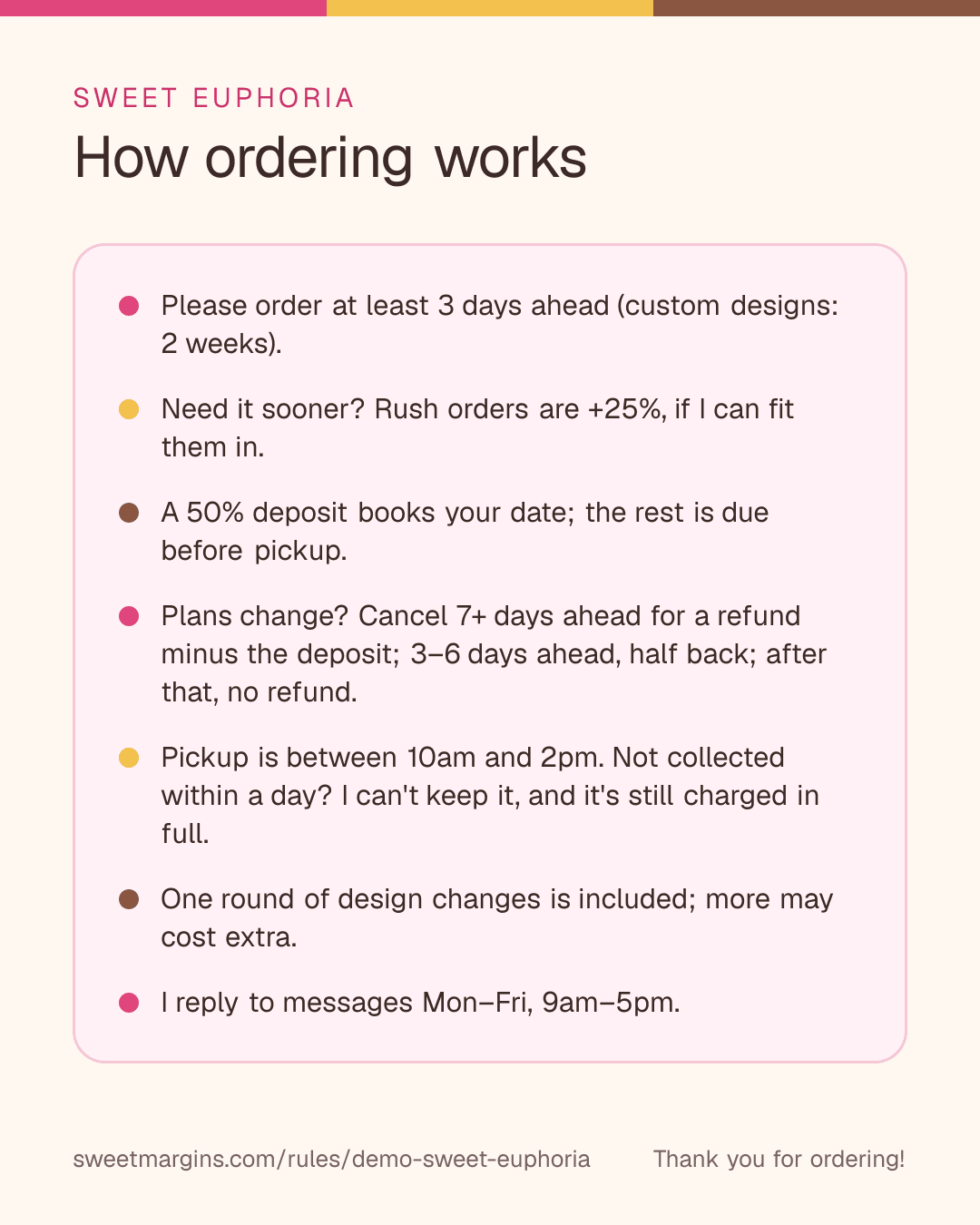
In Settings → Rules, you tap your choices instead of writing anything: how much notice, rush orders, a cancellation rule (Flexible, Standard or Strict), pickup times, design changes and your reply hours. SweetMargins turns them into short, friendly lines and shows them:
- on your order page, with the “I've read these” tick saved on each order;
- on invoices, payment pages and the order PDF;
- on a page of their own, with a ready-made image like this one for Instagram.
It also holds the line. Customers can't pick a date sooner than your notice; they're offered the earliest you can do instead, or it becomes a rush order with your fee. When a customer cancels, the refund is worked out under your rule and included in the message. On WhatsApp, people who message outside your hours are told when you'll be back.
Customer's phone
Sweet Euphoria
Set your rules once. We'll say them kindly.
Free to start. Rush orders and WhatsApp come with Pro.